The Missing Middle Between Server and Yelp
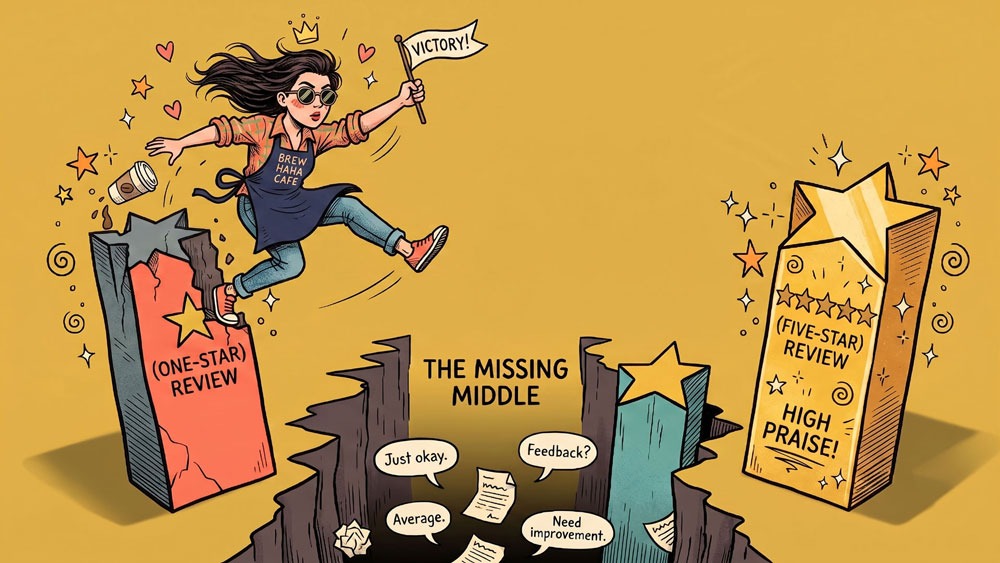
Your customers notice things a hundred times a day. Cold bread, a loud table, a portion smaller than expected. Saying it out loud makes a scene, and posting it online makes it permanent, so almost all of it goes nowhere. This is the missing middle of customer feedback: private, low-stakes, in the moment, and worth more to your business than any star rating.
Something happens at your restaurant a hundred times a day, and you never hear about it. The bread comes out a little cold. The table next to a couple gets a little loud. A portion looks smaller than the customer pictured when they ordered it.
None of it is trivial, if it keeps happening. But none of it is scene-worthy either, so it just sits there, a private, one-second reaction with nowhere to land. It only ever has two places it can go. It can be said out loud, to the person standing right there, mid-bite, while the server hovers with the "how's everything" smile. Or it can be carried home, typed into a laptop, and posted to the internet, forever, attached to a real name.
But neither move fits a cold piece of bread. Say something out loud, to a stranger, over something this small, and it stops being a comment. It becomes a situation. New bread has to come out. A manager might get looped in. Now the person at table six is the guy with the bread emergency.
So most people don't say it. When the server leans in with "how's everything?", the answer comes back automatic: everything's great, thanks so much. The question was never really a question to begin with. It's a treaty, an agreement that nobody is going to make this a whole thing. The cold bread gets eaten anyway. The reaction just disappears, no record anywhere.
Now multiply that by everything else a person notices in a single visit and never says. The table that got a little loud. The sugar that vanished from the tables sometime in the last year, for no reason anyone announced. The portion that came out smaller than the picture in their head. By one recent industry count, more than half of unhappy customers never say a word. They just quietly stop coming back. And even the reactions that do get spoken out loud mostly get spoken offline, friend to friend, never once reaching the business they're about. The Keller Fay Group spent years measuring word of mouth and found that the overwhelming majority of it happens face to face, off the internet entirely, which is exactly where a business can't see it.
So where is all of that going?
You'd think somebody had already built something for this. In a sense, several somebodies have: the comment card on the way out, the after-visit survey, the one-question NPS poll, the smiley-face kiosk by the door, the tablet that now sits where the check folder used to.
But peel back any of them and it's the same tool wearing a different costume. Each one requires the business to ask first, instead of the customer volunteering. Each one arrives after the moment has already passed, instead of catching it live. And each one squeezes a whole textured reaction down into a single number, discarding the reason behind it. Ask someone to rate a six-and-a-half dinner on a scale that only does whole numbers, and watch the "why" disappear into a seven.
That compression turns dangerous the moment the number becomes a performance metric. One table-tablet company, by its own count, watched response rates jump from around one percent of diners to roughly a quarter of them once its screens hit the tables. Response went up. Understanding didn't. When BuzzFeed News spent time with servers working under those tablets in 2018, it found them getting docked a star because the kitchen, not them, undercooked a burger. Once a measure becomes a target, it stops being a measure.
So instead of occupying the middle, every one of these tools snaps back into being a miniature confrontation or a miniature public review, just with more steps in between.
Here's the part that should actually worry an owner. These tools don't just fail to capture the middle. They quietly change what you think you know. What you actually see, day to day, is a star average and the occasional written review. And that isn't a fair sample of what your customers think. It's closer to the opposite.
Online reviews follow a well-documented J-shape: mostly five stars, a meaningful chunk of one stars, almost nothing in between. Not because most experiences are extreme. Because the only people who bother to write a review are the ones who loved it or the ones who are furious.
Three stars, you could say, is a person who noticed things and went home.
The clearest proof came from an experiment where an entire population was made to leave a review instead of opting in. Same customers, same experiences, except this time nobody could self-select out. The J-shape vanished. The curve came out looking ordinary, a bell, not a J.
Which means the two numbers an owner actually has, the average and the rare written review, are the least representative data available to them. What's missing is the middle itself: quiet, moderate, and entirely fixable.
And this isn't a small leak. It's real value evaporating, every single day.
Across multiple countries, researchers have found that when a customer actually comes up with a concrete idea for how something could be better, roughly eight in ten of those ideas never get told to another person, let alone the business. The fix just dies in someone's head. So what's sitting in the middle isn't a rounding error. It's the bulk of the useful information that exists.
That missing information costs real money, and it costs it in exactly the place it hurts most. A single star, up or down, on an online review swings an independent restaurant's revenue by something like five to nine percent. The same swing barely moves a chain, because a chain has a brand behind it and an independent doesn't. The businesses least able to absorb a bad read of their own reputation are the ones getting the worst data.
And the payoff for fixing this, when it happens, is lopsided in the other direction. It's an old finding, from customer-service studies that go back to the 1980s, but it has kept showing up since: customers who spoke up and got their problem fixed often end up more loyal than customers who never hit a problem in the first place. Not loyalty built on a flawless night. Loyalty built on being heard.
Flip it around to the owner's side and the shape gets even clearer. "Everything's great" a hundred times a day tells you almost nothing. Then, weeks later, something shows up on the internet, permanently. By the time you see it, it's too late to fix it for that customer. It can only warn you about the next one.
Step back from any single restaurant and the pattern isn't really about restaurants at all. It's a shape that shows up elsewhere. Businesses too big for a microloan and too small for a bank get called the "missing middle" in small-business lending, a trillion-dollar gap development economists have spent years trying to fill.
That analogy comes with a built-in honesty check worth keeping, because economists actually went looking for a literal hole in the data, a business size that just doesn't exist, and didn't find one. What they found instead was a smooth decline. No dramatic gap. No missing rung. Just a slope. (Which, if you're keeping score, is the responsible thing to admit before you build a whole argument on a metaphor.)
So the lesson isn't "there's a hole where nothing exists." It's "the undifferentiated middle gets squeezed until somebody builds something that actually fits it."
Customer voice has the same shape. Once you can name what's missing (private, low-stakes, in-the-moment, volunteered, and currently unaddressed by anything), it stops looking like a flaw in your customers, or a flaw in your hospitality. It starts looking like exactly what it is: a rung nobody built onto the ladder yet.
Which brings it back to the three stars somebody left you last month. The "everything was great, thank you so much" on the way out tonight. The regular who used to come in every other week, and you haven't seen in two months, and you don't know why.
None of that was ever "fine." Every bit of it was real, fixable information. Every bit of it had nowhere to go.
Somewhere tonight, at some table in your restaurant, the bread is a little cold. Nobody is going to tell you.
That was never a flaw in your customers. It's a gap in the channel. And a gap in a channel, unlike a gap in character, can be built for.