What Actually Counts as Actionable Intelligence
You got more of what customers notice than ever, and Monday still beats you. The pile hands the health-code emergency and the compliment about the playlist the same dash and the same line. Volume was never the problem. The one thing that matters is buried in a flat stream that decides nothing. Here is what actually counts as actionable, why recurrence is the free signal you already own, and the one test that tells you the sort finally did its job.
 July 5, 2026
You did the thing everyone told you to do. The advice never changes. Get more of what your customers think. Find out what they notice. Open more ways for it to reach you. So you did all of it. And it worked, at least by the one measure you were handed. The pile of what customers notice is bigger than it has ever been. By every number you were told to watch, you're winning.
But.
Then Monday comes, and the pile beats you. You sit down to go through it, and the urgent thing and the passing thing are roommates. Same font. Same little dash in front of each line. "Men's room, no soap" sits one line above "love the playlist," and the two look exactly alike.
One of those is a health-code situation unfolding on your floor right now. The other is a nice thing a stranger felt about a song. Your pile handed them the same dash and the same line, so they carry the same weight. Nobody decided that. It just happened, because nothing in the pile decides anything.
You read all of it. You feel on top of it. Then you stand up not knowing what to do first.
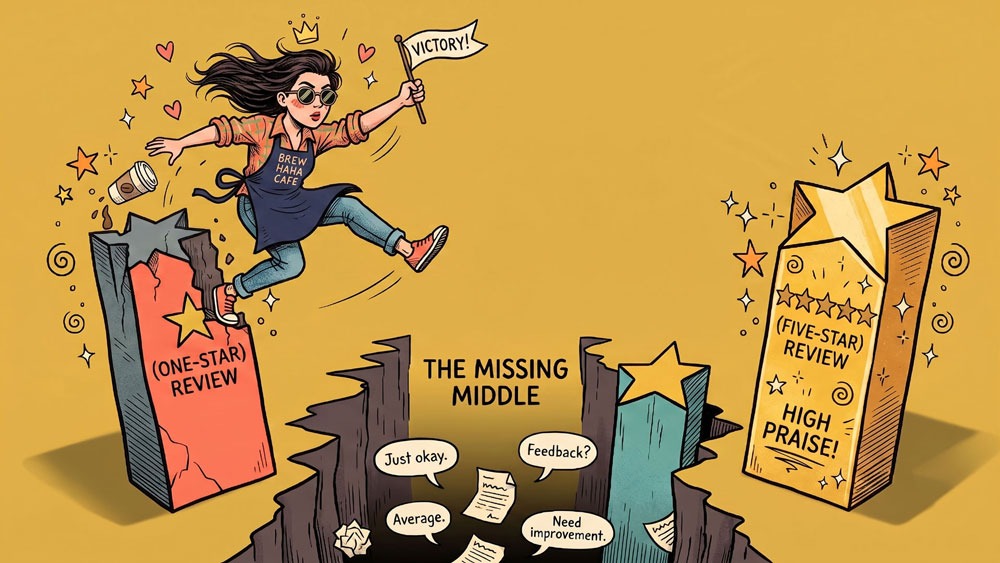
Volume was never the problem. Prioritization was. What's broken isn't how much comes in. You solved that. What's broken is that nothing in the pile tells you which line is the power going out and which line is one person's mood in a doorway. A system that flags everything the same way isn't neutral. It only feels neutral. And feeling neutral is exactly how the one thing you needed to see gets buried, dropped into the same flat stream as everything else.
This isn't a marketing opinion. Somebody already ran the experiment for real, in a room nobody could accuse of selling you software. Hospitals.
The machines at every bedside alarm on everything. And The Joint Commission found that between 85 and 99 percent of those alarms don't need anyone to do a single thing. Picture that volume. One intensive-care unit logged 2.5 million alarms in a single month. That's 187 per bed, per day, and nearly 89 percent of the heart-rhythm ones were false. Faced with a channel that screams all day, the staff did the only thing a human can do. They stopped hearing it.
Tuning out a channel has a body count. Over three years, hospitals reported 98 alarm-related events and 80 deaths, all tied to people who had learned to ignore the noise.
The same failure shows up nowhere near a hospital. Study security teams and you find the identical thing: analysts wave off a quarter to a third of their alerts, because the queue floods past anything a person can read. Two fields, opposite worlds, one exact lesson. When everything is urgent, people tune out the whole channel. Not the noise. The channel. Including the one signal that mattered.
So what actually counts as actionable? Not "a human near your place mentioned it." That's just raw material. Actionable is three things you can read off any comment for free, without buying a thing. How much it hurts. Call that impact. How fast it's getting worse. Call that urgency. How many times it's come back. Call that recurrence.
None of this is new. It predates your inbox by two centuries. Napoleon's surgeon sorted the wounded by how bad the wound was, not how high the rank, and every triage system since, from the emergency room to the IT help desk, runs on that same core. Impact times urgency. Read a comment through that lens and a repeated facility problem is a counted pattern, while a one-off preference is an anecdote. Left alone, though, your brain reaches for the loud anecdote every single time. It's wired to.
Of those three, one costs you nothing. Recurrence.
Six strangers agreeing is not six coincidences. It's a verdict. When people mention the same thing separately, weeks apart, none of them knowing the others exist, that isn't a pile of opinions. It's an accidental committee. No moderator, no meeting, nobody organizing it, and it reached agreement anyway. That makes recurrence the cheapest signal you already own. It's also the one the pile flattens hardest. The fifteenth quiet mention of the slow checkout line looks exactly like the first. Same font. Same dash. The pile has no memory, so it can't tell you this is the fifteenth time.
That committee never raises its voice. It just keeps showing up, calm and polite, one quiet mention at a time, trusting you'll notice on your own. Which is the part worth flipping in your head. A thing that keeps coming back isn't nagging you. It's the truest signal you've got.
But recurrence alone would lie to you if you let it be the only judge. The rare thing that happened once can still be the one that matters most. Frequency is a filter, not a judge. A single believable safety or health signal has to jump the line on its stakes alone. It can't wait around for a pattern to form, because by the time the pattern forms, it's too late. So real scoring weighs severity right next to recurrence. Sometimes the quiet wheel is the one about to come off.
That's the whole point of scoring each hint on how actionable it truly is. Not a bigger inbox. You already have a big inbox. What you don't have is a pile that sorts itself, so the repeated facility issue climbs to the top and the doorway preference doesn't drown it out. Give it that sort, and you stop being the intake nurse running triage by mood on a Sunday night. The thing that kept coming back finally arrives already flagged, right at the top, where it had been quietly trying to get the whole time.
Here's the test. One question. You finish reading, and you know what to do Monday. That's it. If the answer depends on what mood you're in that morning, the pile won. If it's obvious no matter your mood, the sort did its job.
The one that mattered was never the loudest. It was the one that kept coming back. Actionable intelligence is just knowing the difference before Monday.